Dayspring Software Review - Policy Management Software That Gives Small Teams Exportable Audit-Ready Evidence
Welcome to our in-depth Dayspring Software review.
If your business has ever been asked the same uncomfortable question by a customer, an auditor or a regulator, you already know the feeling. "Can you prove your team actually read and follows this policy?" For most small companies the honest answer lives in a messy trail of email threads, shared drives and spreadsheets that nobody quite trusts. I spent time working through Dayspring to see whether it actually fixes that problem or just adds another dashboard to maintain.
Dayspring positions itself as a policy management platform built for small and mid-sized businesses that get reviewed by outsiders. That could be ISO 9001 or ISO 27001 certified firms, law firms, accountancies, or any supplier answering RFIs and vendor questionnaires. The pitch is simple. Dayspring is not another enterprise governance suite that needs a compliance team to run it. It is a focused tool that makes sure you can produce exportable evidence that your policies are actively managed.
After going through the platform's stated workflow and feature set, here is my honest take on what Dayspring does well, where it fits, and who should look at it.
The Problem Dayspring Actually Solves
Most small businesses do not have a "policy problem" in the sense of lacking documents. They have documents. The trouble shows up at review time. An auditor asks who owns the information security policy, what changed between versions, and whether staff actually acknowledged it. Suddenly someone is digging through a shared folder named "Policies_FINAL_v2_REAL".
Dayspring frames this clearly on its site. The old way is reactive: documents scatter across versions, old copies stay accessible, ownership is unclear, and there is no record of what changed or when review was due. The Dayspring way is proactive: a central library with version control, automatic archiving, clear permissions, recorded changes, and scheduled review cycles with reminders.
That difference is the whole product. It is not about writing better policies. It is about being able to answer the auditor's questions without a panic the week before the visit.
The questions are remarkably consistent, whoever is asking. An ISO 27001 auditor, a SOC 2 assessor, an SRA inspector, a cyber insurer's questionnaire, or a large customer's procurement team running supplier due diligence will all land on roughly the same set:
- "Can you show me policy X? Is this the current version?"
- "Who has access to this policy? How do you know they've read it and follow it?"
- "When was this policy last reviewed? What changed, and why?"
- "How do you ensure policies are communicated to the right people? Do you have records of this?"
- "If this policy was updated six months ago, can you show me the previous version and the reason for the change?"
The tool you choose needs to make all of those easy to answer, ideally by generating a shareable report in a few clicks rather than reconstructing history from email screenshots and file metadata. That is exactly the gap Dayspring is built to close.
Understanding Dayspring: What It Is
Dayspring is a policy management SaaS hosted on an ISO 27001 certified platform. That matters more than it sounds. Your compliance evidence is stored inside a system that itself meets a recognized security standard, which is a reassuring detail when you are the one being assessed.
The workspace model is team based. Each workspace needs a minimum of three full seats, which tells you the product is designed for a small core team collaborating rather than a single person ticking a box. You centralize policies, assign reviewers, set annual review cycles, and let the system chase acknowledgements on your behalf.
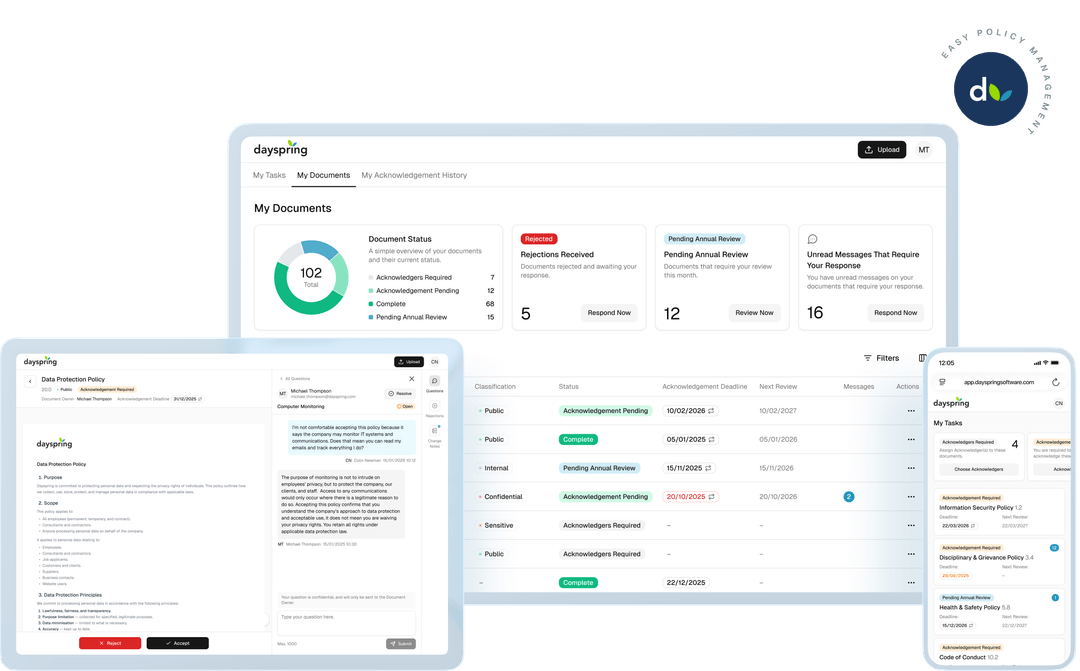
The interface is described by the vendor as a single, secure and intuitive hub. I could not find public UI screenshots to verify the visual design, but the stated goal is to replace a patchwork of manual document processes with one place. For a non-technical user that is the right ambition. You should not need a compliance expert or an IT project to operate it.
Why Choose Dayspring?
- 📁 Centralized document storage: One library instead of scattered versions across drives and inboxes
- 🔒 ISO 27001 certified platform: Your evidence lives in a security-certified environment
- 🤖 AI-enabled automations: Policy comparison and workflow reminders handled without manual chasing
- 📝 Exportable, audit-ready reports: Evidence you can hand to an auditor on demand
- 👥 Clear access control: Know who owns and can see each policy
- 🔄 Version-specific acknowledgements: Prove exactly which version each person confirmed
- 💷 Transparent seat-based licensing: Pay for the seats you need, no hidden tiers
Key Capabilities: What Makes Dayspring Different
Version-Specific Acknowledgement Records
This is the feature I think matters most for anyone facing audits. Dayspring produces acknowledgement reports that are version specific, immutable and timestamped. They prove a policy or compliance document was communicated and then accepted by employees, contractors or suppliers. When an auditor asks "did your staff actually read this", you do not point at a folder. You export the record.
Version Control and Change Management
Old versions are automatically archived, and you can roll back when needed. That ends the "Policy_V2.0_final_final" naming mess. Change management is structured: each update carries a note on what changed, why and when, with a timestamp. Version history is exportable as PDF or CSV, which is exactly the format reviewers tend to want.
AI-Driven Policy Comparison
Dayspring lists AI-driven policy comparison as a core capability. Rather than reading two long documents side by side, the platform helps you see what shifted between versions. Combined with the change notes, this is genuinely useful for the person responsible for keeping policies current without re-reading everything from scratch.
Scheduled Review Cycles and Automated Reminders
You set annual review cycles, and Dayspring sends automated reminders when a policy is due. It also sends automated emails to share documents with reviewers and chase their acknowledgements. For small teams where "review the policy" always slips down the to-do list, that nudge is the difference between being ready and scrambling.
Access Control and Information Classification
Policies can carry information classification labels, and access is controlled per document. Suppliers and external collaborators get guest seats that let them review and acknowledge without full platform access. That keeps outsiders in the loop without opening up your whole workspace.
How Dayspring Works, Step by Step
The vendor lays out a five-step workflow:
- Centralize your policies in an ISO 27001 certified platform
- Choose reviewers and set annual review cycles
- Get evidence that staff read and acknowledged each policy
- Get automated reminders when policies are due for review
- Get a record of every policy change: what changed, why and when
That sequence is the product in a nutshell. It is a loop, not a one-time setup.
Dayspring vs. The Spreadsheet Approach
Small businesses often "manage" policies in a shared spreadsheet or a documents folder. Here is how the two compare on the things that actually get questioned.
| Capability | Dayspring Software | Shared drive + spreadsheet |
|---|---|---|
| Proof a person read a policy | Version-specific, timestamped record | Email reply, if anyone kept it |
| Old versions | Auto-archived, roll back anytime | Copies pile up, easy to open wrong one |
| Change history | What, why, when with notes | Usually none |
| Review reminders | Automated, on a cycle | Manual, easy to forget |
| External reviewer access | Guest seats, limited view | Forward the whole file |
| Audit-ready export | PDF or CSV, on demand | Built by hand under pressure |
The spreadsheet is free, but it does not answer the auditor. Dayspring's job is to make that answer exist before anyone asks for it.
Why the Enterprise GRC Tools Don't Fit Small Business
It is tempting to assume "more features" means "safer choice". In practice, the broad GRC platforms tend to work against a small team. Dayspring's own comparison of the category is worth keeping in mind, because the pattern repeats across vendors.
| Tool | Built for | Free trial | Published pricing | Small-business fit |
|---|---|---|---|---|
| Dayspring | Small regulated/accredited businesses | 30 days | Yes, from £10/user/mo | Purpose-built, same-day setup |
| StaffWiki | Wiki-style internal knowledge base | 7 days | From $65/mo base | Broad but governance-light, more admin than needed |
| DocTract | Mid-large healthcare/edu/gov | None | Sales only, ~$5-10k onboard | Long implementation, needs IT team |
| ComplianceBridge | Broad GRC (risk + policy + audit) | None | Sales only, quote tiers | More platform than the problem requires |
| IdeaGen (ConvergePoint) | Microsoft 365 / SharePoint shops | None | Sales only, ~$15k/yr | Inherits SharePoint complexity, no self-serve |
| PowerDMS | US public safety / accreditation-heavy | None | Sales only, ~$8-12k/10 users | Strong if you're public safety, else misfit |
The takeaway is consistent. Tools like DocTract, ComplianceBridge and PowerDMS are aimed at organisations with dedicated compliance and IT teams, charge onboarding fees in the thousands, and often need a structured sales engagement before you can even price them. For a business where one person owns policy management alongside several other jobs, that is more platform than the problem requires. Dayspring sits at the other end: per-seat pricing published upfront, guest seats for people who only read and acknowledge, and out-of-the-box workflows so a non-expert can go from sign-up to a first acknowledged policy in roughly an hour.
A Real Result: CloudTamers Cut Audit Prep from 300+ Hours to 5-10
Numbers matter more than promises, so it is worth noting a documented case. CloudTamers, a UK Oracle NetSuite partner of about 20 people, used to assemble audit evidence by hand. Policies were tracked down across SharePoint, updated, and their version history rebuilt from memory into a spreadsheet, then emailed to staff one by one with every acknowledgement logged in a second spreadsheet. Preparing for one customer audit took them over 300 hours.
After moving their policies onto Dayspring, that same preparation now takes between 5 and 10 hours. That is roughly a 97% reduction in team time spent on policy management, and it is the kind of figure an auditor-facing SMB cares about far more than a feature checklist. The point is not that Dayspring writes your policies. It is that the evidence an enterprise customer's vendor-risk team asks for, version history, change notes, acknowledgement records, becomes something you export rather than something you reconstruct.
Practical Applications: Where Dayspring Helps
ISO 9001 and ISO 27001 Maintenance
SMBs pursuing or maintaining these certifications face the same recurring question from assessors. Is this policy up to date, who owns it, what changed, and do staff follow it? Dayspring is built to answer all four with recorded evidence. The ISO 27001 certified platform detail is a nice alignment, since your management system evidence sits inside a certified environment.
It is also worth being precise about what ISO 27001 actually demands, because the misconception costs small businesses time. The standard names only one policy as compulsory: the Information Security Policy (clause 5.2). Everything else flows from a risk assessment against Annex A's 93 optional controls, which most businesses group into 15 to 25 policies. A consultant selling you a fixed "30 template policies" bundle is selling more paperwork than the standard requires. Dayspring is built around the document-control requirements this produces: a named owner per policy, a review date, version-change records, and proof of communication to the right people.
SOC 2 and SRA Compliance
The same evidence engine covers neighbouring frameworks. SOC 2 assessors want to see that security and operational policies exist, are communicated to relevant staff, and are reviewed periodically. A single source of truth with exportable version history and acknowledgement records covers the core evidence. For law firms, the SRA expects compliance policies on AML, data protection, conflicts of interest and complaints handling to be current, formally communicated to all staff, and maintained. Dayspring's acknowledgement tracking and exportable reports are designed to produce exactly the evidence an SRA inspection asks for.
Professional Services Firms
Law firms, accountancies and consultancies often need to show formal policy governance to regulators and to professional indemnity insurers. The pressure is concrete, not theoretical. The SRA and the Bar Standards Board expect law firms to evidence that compliance policies on AML, data protection and conflicts of interest have been formally communicated to every member of staff, not just filed away. Cyber insurers have joined the list too, increasingly making proof of policy governance, acknowledgement records, version histories and documented review cycles a condition of cover or renewal. The consequences of weak governance range from fines to being unable to get cover. Dayspring gives these firms a structured, defensible record without hiring a dedicated compliance function.
Hiring Internationally
A less obvious but growing use case is the first international hire. An Employer of Record (EOR) makes the hire legally possible, but your own internal policies stay your responsibility. Once a new hire sits in another time zone, possibly another language, the informal "ask in Slack" method breaks down, and auditors increasingly ask specifically whether acknowledgement covers remote and international staff. Dayspring makes sure every employee, wherever they are, sees the same policy, can ask about it, and gets their acknowledgement recorded. Skipping policy management while going international leaves you with no way to confirm a remote hire has actually seen your rules, and no evidence if a client, auditor or insurer asks for it.
Supplier and Vendor Questionnaires
When a larger customer sends an RFI or a vendor security questionnaire, one common request is evidence of policy acknowledgements. Instead of assembling it by hand, a Dayspring user exports the relevant reports. That turns a half-day task into a few clicks.
Annual Review Discipline
Setting review cycles and letting automated reminders do the chasing means policies get looked at on schedule. For teams without a compliance owner, that quiet automation is the main value.
Pricing: What Does It Cost?

Dayspring uses transparent, seat-based licensing. The headline is a 30-day free trial that includes 3 full seats and access to all platform features, so you can evaluate the whole product before paying.
There are two seat types:
Full Seats are for your internal team. They get the full range of platform features and actively manage documents. Pricing starts at £10 per user per month (annual billing) or £12 per seat per month (monthly billing). Each workspace must have a minimum of 3 full seats, because Dayspring is built for teams rather than solo users.
Guest Seats are for suppliers and external collaborators. They review and acknowledge documents without full platform access. Pricing starts at £2.50 per user per month (annual billing) or £3 per seat per month (monthly billing). There is no minimum number of guest seats.
You can adjust seat counts as your team or supplier network changes, and payments are processed securely through Stripe. Enterprise onboarding for large teams or supplier networks is handled by contacting sales directly.
The minimum of three full seats is worth noting. If you are a true one-person operation, the model assumes you still bring in at least two others, which fits the "policies get acknowledged by people" purpose.
Honest Assessment: Strengths and Limitations
Where Dayspring Excels
Evidence on demand: The acknowledgement records and exportable reports are the core strength. They directly answer the questions auditors ask.
Built for non-experts: The vendor is explicit that this is for non-technical users and non-compliance experts. That focus keeps the product approachable instead of enterprise-heavy.
ISO 27001 platform: Storing compliance evidence in a certified environment is a credible choice for the audience it serves.
Transparent pricing: Seat-based, no hidden tiers, with a real free trial. Easy to reason about.
AI where it helps: Comparison and reminders are practical uses of automation rather than buzzword features.
Limitations to Consider
Team minimum: The 3 full seat minimum means very small setups pay for collaboration they may not fully use.
Niche scope: Dayspring is a policy management tool, not a broad GRC or risk platform. If you need deep risk registers or enterprise workflow engines, it will feel narrow.
English-only limitation: Dayspring is currently an English-only platform, so it is not the right fit for organisations managing policies across multiple languages or non-English-speaking teams.
Visual verification: I could not find public screenshots of the interface, so the "intuitive hub" claim is taken from the vendor rather than confirmed by me.
The honest summary is that Dayspring wins by staying narrow. It does one job, producing defensible policy evidence, and does not pretend to be a full governance suite.
Who Should Use Dayspring?
Great Fit For:
- ISO 9001 or ISO 27001 certified SMBs that need to answer assessors without a compliance team
- Law firms, accountancies and consultancies proving policy governance to regulators or insurers
- Suppliers answering RFIs and vendor questionnaires from larger customers
- Small teams that struggle to keep review cycles on schedule and want automation to help
- Non-technical owners who need a tool their staff can actually use
Not Ideal For:
- Solo operators who cannot justify three full seats
- Enterprise GRC buyers needing risk registers, control frameworks and complex workflow engines
- Teams wanting a full security or risk platform rather than focused policy management
Market Position: How Dayspring Fits
The policy and compliance space splits into two ends. On one side are enterprise GRC platforms with heavy setup and pricing built for large teams. On the other are nothing, where small businesses keep policies in shared folders and hope for the best.
Dayspring sits in the gap. It takes the evidence-generation discipline enterprises pay a lot for and packages it for a small business that gets reviewed by customers, regulators, auditors or inspectors. The ISO 27001 certified platform and seat-based pricing signal that audience clearly.
What separates it from a documents folder is not the documents. It is the recorded, exportable proof that policies are live, owned, reviewed and acknowledged. That is the part auditors actually check.
Final Verdict: Is Dayspring Worth It?
For a small business that faces external review, Dayspring solves a real and recurring problem. The value is not in storing policies. It is in being able to show, on demand, that those policies are actively managed. Version-specific acknowledgements, change records and automated review reminders turn compliance from a scramble into a steady habit.
If your policies are only ever opened when someone asks for them, Dayspring is worth a serious look. The 30-day trial with three full seats costs nothing to test, and you will know quickly whether the workflow fits how your team operates.
Review Summary
- Ease of Use: ⭐⭐⭐⭐⭐ (5/5) - Built for non-technical users
- Evidence Quality: ⭐⭐⭐⭐⭐ (5/5) - Exportable, audit-ready records
- AI Automation: ⭐⭐⭐⭐ (4/5) - Useful comparison and reminders
- Security Posture: ⭐⭐⭐⭐⭐ (5/5) - ISO 27001 certified platform
- Pricing Transparency: ⭐⭐⭐⭐⭐ (5/5) - Clear seat-based model
- Scope Fit: ⭐⭐⭐⭐ (4/5) - Narrow but focused on the right problem
Ready to Try Dayspring?
If keeping policy evidence organized sounds like a weight off your team's shoulders, you can try it free for 30 days with full features. 👉 Start your free trial and see how exportable audit-ready evidence changes your next review.
Follow for new blogs
Subscribe to our blog
Subscribe to Newsletter
Subscribe to our newsletter to get the best products weekly.